


Teaching and Learning
Highams Park School is committed to delivering a broad and balanced curriculum across all three Key Stages, offering a diverse range of subjects so that students can explore and develop their interests and passions. We believe every student is capable of achieving success, and this belief underpins all aspects of our work.
High-quality teaching lies at the heart of our provision. Our skilled staff provide the appropriate level of support and challenge to help students secure essential knowledge and achieve strong academic outcomes. Alongside this, we promote the personal qualities and life skills needed for students to flourish beyond school and enjoy sustained success and wellbeing.
We recognise our teachers as subject specialists and trust them to use their professional judgement to make classroom decisions that best support their learners.
Our approach to teaching and learning is informed by Rosenshine’s Principles of Instruction, which shape lesson design and delivery across the school. Rosenshine’s Principles are a set of evidence-informed teaching strategies drawn from research into how people learn, remember and build knowledge over time, as well as from observations of highly effective classroom practice. They emphasise carefully sequenced learning, where new material is introduced in small steps and understanding is continually checked and reinforced.
Developing a shared language around these principles allows us to establish a common understanding of what effective teaching looks like at Highams Park School, while still recognising that each subject has its own disciplinary approaches. It enables staff to discuss modelling, checking understanding, practice and retrieval using consistent terminology, supporting constructive professional dialogue that promotes improvement rather than judgement. In turn, this ensures greater consistency across classrooms without requiring identical teaching styles, and allows us to clearly explain our approach to colleagues, parents and inspectors using a shared, evidence-informed framework.
We expect all staff to continually develop their practice by reflecting on its impact and engaging in ongoing professional learning to maintain the highest standards for our students.
The Principles of Instruction
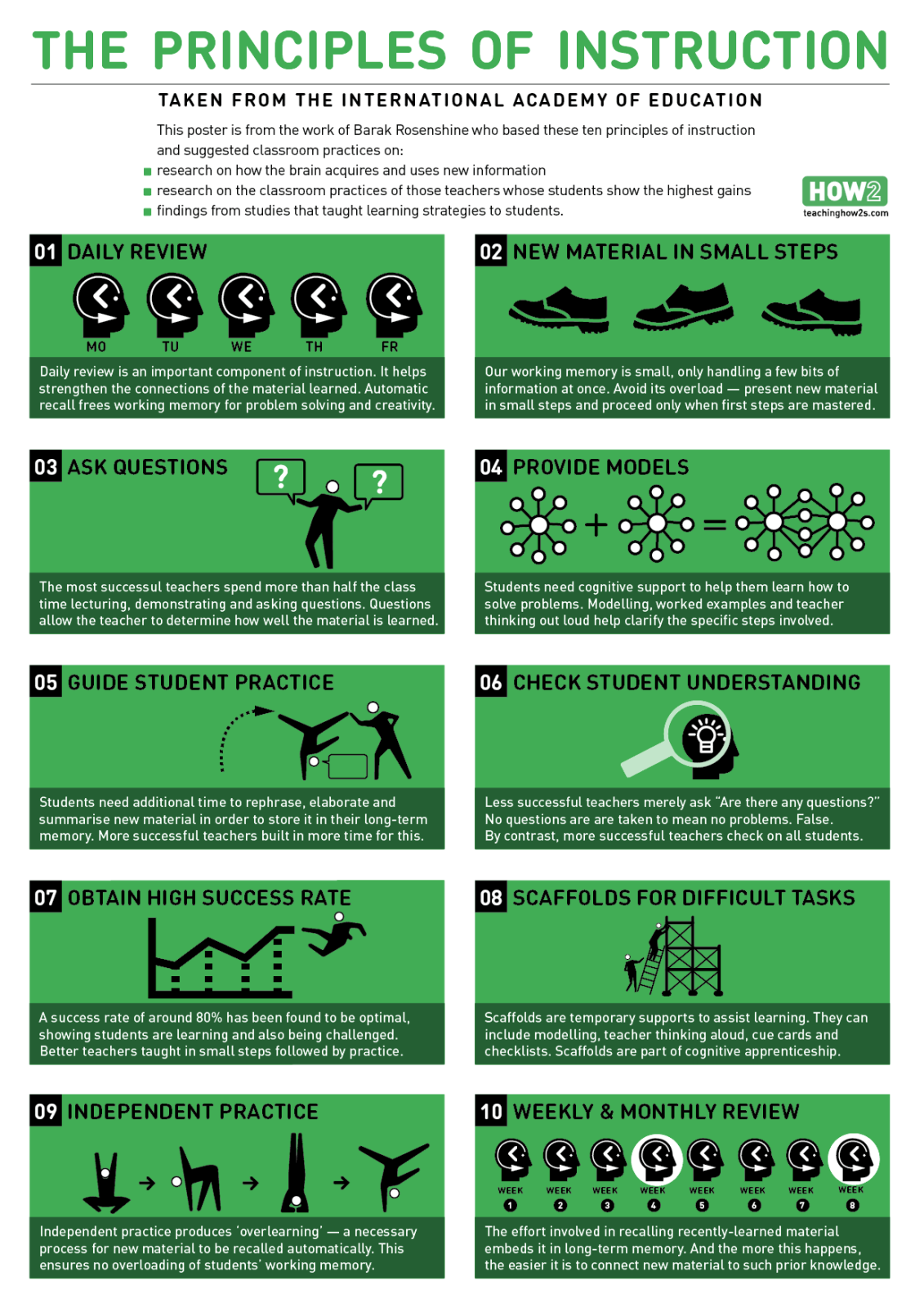 1. Daily review
Begin each lesson with a short review of previous learning: Daily review can strengthen previous learning and can lead to fluent recall
2. Present new material using small steps
Present new material in small steps with student practice after each step: Only present small amounts of new material at any time, and then assist students as they practice this material
3. Ask questions
Ask a large number of questions and check the responses of all students: Questions help students practice new information and connect new material to their prior learning
4. Provide models
Providing students with models and worked examples can help them learn to solve problems faster
5. Guide student practice
Successful teachers spend more time guiding students’ practice of new material
6. Check for student understanding
Checking for student understanding at each point can help students learn the material with fewer errors
7. Obtain a high success rate
It is important for students to achieve a high success rate during classroom instruction
8. Provide scaffolds for difficult tasks
The teacher provides students with temporary supports and scaffolds to assist them when they learn difficult tasks
9. Independent practice
Require and monitor independent practice: Students need extensive, successful, independent practice in order for skills and knowledge to become automatic
10. Weekly and monthly review
Engage students in weekly and monthly review: Students need to be involved in extensive practice in order to develop well-connected and automatic knowledge